This was not that great of a listen. The author spent most of the time in somewhat related anecdotal stories, as well as only giving moderately useful guidance on what to do to better yourself. The last book I read “The Power of Habit” was much better, even though it only talks about willpower in one chapter of the book. This book also mirrored much of the Buddhist teachings of mindfulness that I’ve been listening to. It has been a really interesting how I’m hearing those Buddhist overtones in parts of many of the books I’m listening to now. I think it has to do with the ideas being very tested and refined. Western teachings on self-improvement are just catching up to the idea of being mindful. That said, I still don’t agree with some of the other Buddhist teachings.
This went wayyyyy off book, and I’m really interested to see where they take some of the lines that they took irreparably off the book. Gendry, Sansa, and Little Finger were the ones who went way off book. This makes the TV series so much more interesting, since it isn’t following the books exactly. I don’t know what is coming next and that is exciting. I’m going to really enjoy the next few episodes of the story.
I got some nice beer and cider for the viewing, and Nick made some really tasty taco makings. I got the bottles that are readily resealable and paid Trey to get some more next time.
We were joined by Trey, Simon, Nick, Steph, Tony, and Jamie. Riley came over afterwards to watch Once Upon a Time with us.
I got to ride Trooper today, and he wasn’t the most obedient horse I’ve ridden. Belle was a great horse to ride when considering how well she listened. Although Belle was also a great horse to ride in preparation since Belle didn’t listen too much to the reigns when I was directing her. Trooper was the same, but so much worse. I felt really good doing the 2-point in the trot today. The feeling was great to just stand in 2-point while the horse was doing it’s thing under me. I was able to balance there and there was no problems in keeping my control, or being able to direct the horse at the same time. I was really happy about the being able to direct the horse at the same time especially. The biggest problem with Trooper was trying to direct him in general. He really didn’t listen to what I was trying to do.
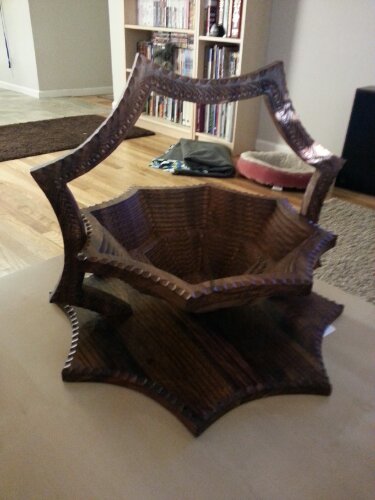
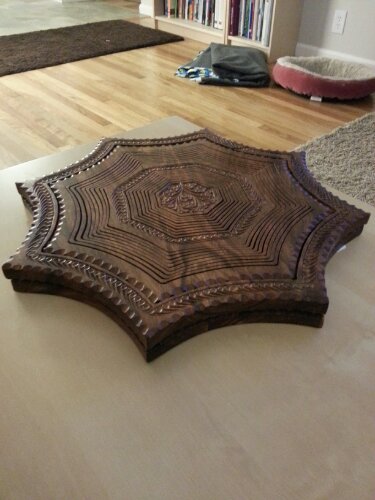
At the mountain view art festival yesterday there was a company that was selling these trivets that turn into a bowl. I got one for Nana, which I will be giving to her when I visit later this month. These are amazing, and I was going to get one for the parents, but Steph was tired. After the nap we went to horseback riding.
Here is the bowl version:
here is the trivet version:

We went over to Adam’s house for a makeup party. We decided that I would do Stephanie’s makeup and that she would do mine. I chose to make her look like an egyptian, she chose to make me a two face.

One side of the face has “normal” makeup and the other has “fancy” makeup.

We did this at Adam’s house with Andrew, Jeremy B, and a couple of people I hadn’t met before. I had a really nice alcohol free diet ginger beer, but I added a little bit of vodka. Adam also made a drink with lavender syrup. Adam also served really nice cheese, it was a goat cheese with garlic and herbs.

After horseback riding Steph and I went straight to Shezan. Castro street at the time had an art fair going on. While we waited for our food at Shezan to be ready we went down the street and looked at some really amazing art. I got something for Nana, and possibly will get something there tomorrow for Dad. After about 20 min we went back to Shezan and got our food, which we took down to Shoreline lake to eat. The lake was really pretty, and I was hoping to see some goslings but no such luck.
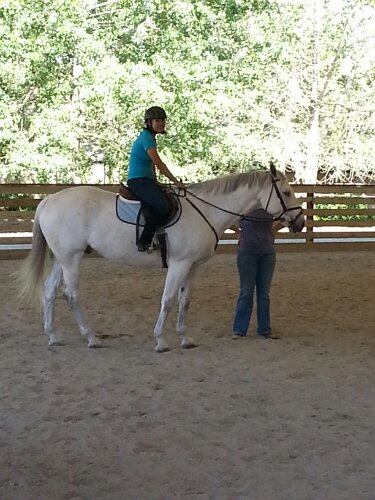
We had an extra lesson of horseback riding today. The weather was a little warm for horseback riding, and my allergies have been giving me tons of problems. Once we got going and my adrenaline got up the allergies seemed to go away nicely, but they game back as soon as I stopped riding. Today I also got to ride Belle, a Belgian draft horse. She is really big, and I look kinda small on her.
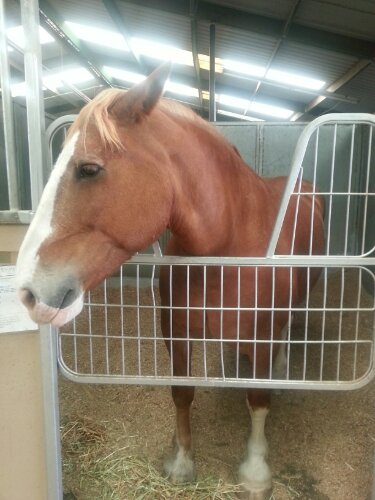
Belle was really responsive to directions of where to go, but not so responsive on how quickly to go there. She also took really wide turns, and didn’t seemed bothered by me being there at all. It was kinda strange being on a horse as big as Belle, since I’m used to it mattering where I put my weight. With Belle, she didn’t really notice too much.
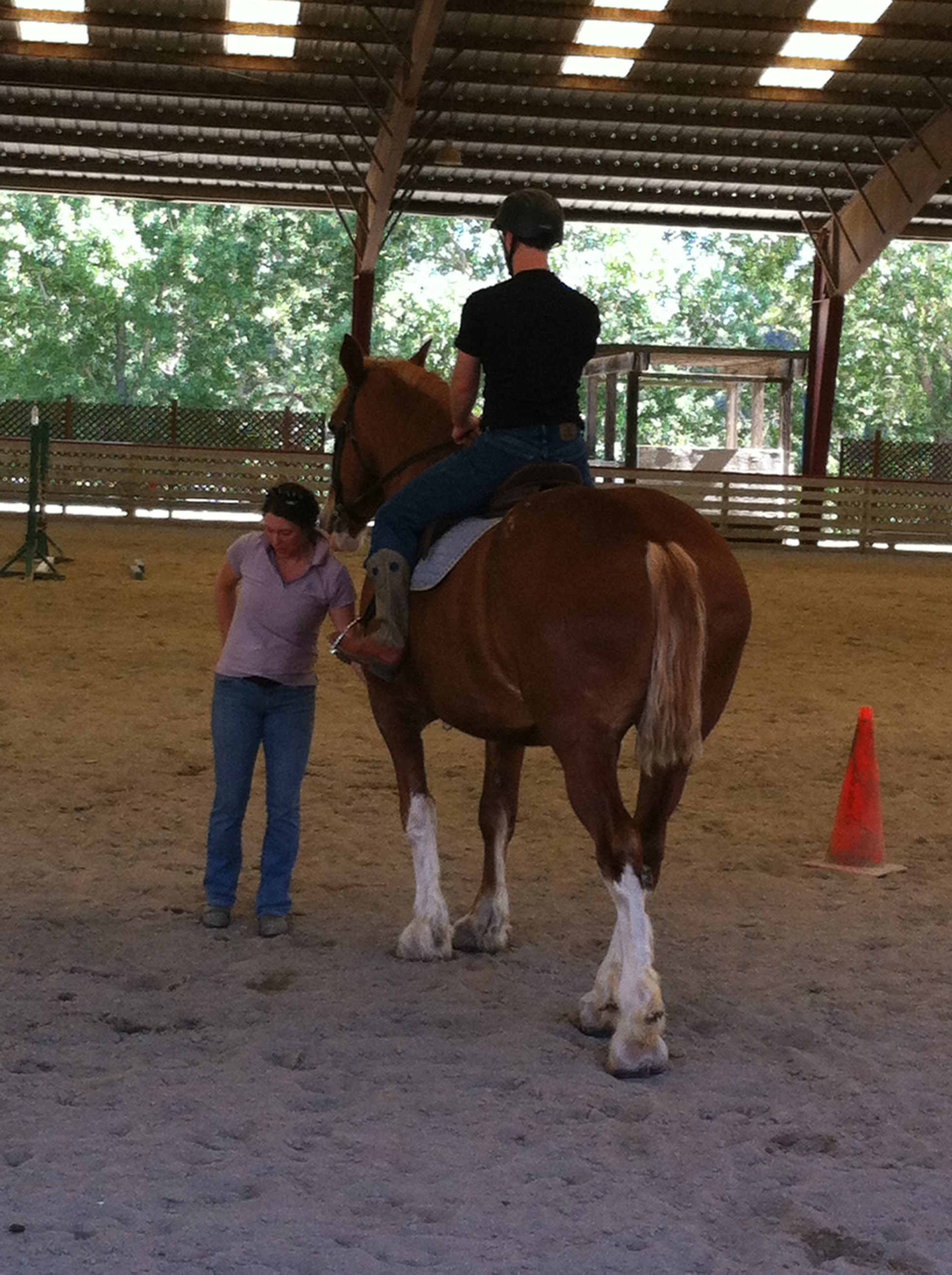
You can see how wide I have my legs splayed over Belle, she is incredibly wide.
Steph and I didn’t get to ride at the same time, but we still got to have a lot of fun. It was interesting to see her ride and watch Carla teach her. They do a lot more precision steering that I have been doing.
While waiting in line and in the movie theater, Nick, Steph, and I played some Stone Age on Nick’s Ipad. I really enjoy this game as it is well balanced, and has several interesting, but not too complex strategies. The randomness is sufficiently limited, but sufficiently random. The best part of the randomness is that you can get items to minimize and optimize the randomness. I really like doing that route, along with the cards. The cards plus tools has seemed to be the winning strategy so far in the games I’ve played, but that is a pretty limited number. We didn’t actually finish the game, but we probably will this weekend.
The plot in this was very predictable, and most of it was obvious. The development was decently shallow, as were the characters. That being said, I really enjoyed robots fighting superhumans. Some of the small twists were pleasant, and the banter was better than most movies. That is somewhat to be expected in an Ironman movie, but it was still pleasant to see. I don’t think I’d want to watch this movie again, as some of the earlier superhero movies had much better plots, and were overall more enjoyable. I went with Steph, Nick, Adam, Brian, Candice, Andrew, and Jeremy B. We went to the AMC Mercado 20 near Great America.

