I went to a potluck at Stanford. Adelaide was hosting it with her roommates in Rains. I got to see Amy, Nima, Caryn, and lots of randoms Stanford people. Stephanie came along and we got to talk to everyone. Amy is now living behind the Zynga Mountain View office. Nima and Caryn are living in Mountain View as well, just down on Latham st. I really enjoy having them close by. I made some Guac for the party and took my veggie juice so that I wasn’t tempted to eat too much. It worked rather well up until the end of the party, when I had a few slices of pizza.
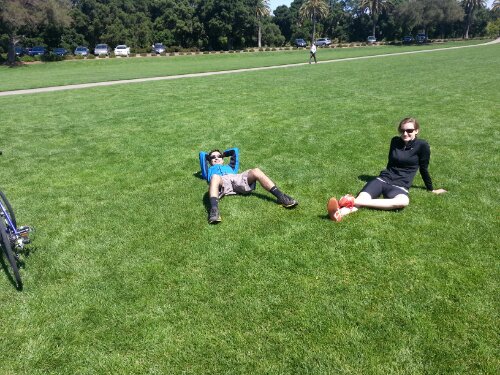
Nima and Caryn took me bike riding this morning through Portola Valley. It was a really intense ride and I was lagging behind a little the entire time. I am going to be walking a little funny tomorrow from it. I really enjoyed the ride, and would love to do it again. We ended the ride with a quick pass through Stanford and sat in the Oval for a couple minutes to cool down. We talked about what we would do if we had no worries about money. Nima would dance, Caryn would get a PhD, and I would do the same things I’m doing now, just with a small difference in the time weighting.
We then went to the Cal Ave farmer’s market to meet up with Steph and Tina. The market had lots of delicious blueberries, and of course I got a Samosa. We sat under the giant metal flowers for a while and chatted. I also got a good bit of broccoli and cucumber.
Today Steph completely destroyed Jeff and myself in a game of Suburbia. She took a very balanced route and got many of the buildings that were just right for her due to Jeff and I going with very specialized strategies. My strategy was the residential one, but the late game buildings that I was hoping for just didn’t show up, or when they did Jeff decided to discard them. Jeff got last with the industrial strategy, since he didn’t go after people until too late in the game. I had the secret goal of least income, but I paid too much attention to it early game and never got my economy fully off the ground. I got 2 HOA’s which gave me an ok stream of income as long as I kept buying the residential buildings, but it restricted me from getting anything really good.
This book had many good stories and facts about the effects of salt, sugar, fat, and marketing. Something I found lacking in the book is any suggestions on plans of actions. It kept saying that something had to be done, and giving small stories about parents moving against vending machines or corner stores. There was no recommendation about how we can systematically change the factors that drive the salt, sugar, and fat phenomenon. Except for that I think the book is very informative and has a good message. I look forward to talking about it more in length with Steph when she finishes.
We went to Holy Grill and talked about what Bo has been doing. He seems to be doing well, but needs to be a lot more insistent on the companies he is helping to hire him or pay him. He seems to be really happy now that Umi is here and they are going to be getting married soon. I found out that Sean Teague is moving to the bay area. I hope Bo is happy wherever he ends up. Also found out that John Forrest just graduated and is looking for a job in robotics for a mechanical engineer.
This book was very good. The arguments were laid out clearly and logically, with anecdotal supporting evidence. The concepts covered were very good, about getting other people to work for you the best that they can. The methods to doing this are creating the right atmosphere, asking good questions, not being the decision maker, and giving individuals more power and responsibility than they would normally get. Where I work has policies that are meant to support this kind of environment, and they work to a certain degree. I’d say this is my number two favorite book so far.
The title of this book is a misnomer. The book has very little about science, and the little it does have is half-science. It isn’t pseudoscience, just all the science in it is reported anecdotally. I was very disappointed by this book. There were also large portions of the book dedicated to meditations and overall expounding on meditation, mindfulness, and enlightenment having nothing to do with science. I would recommend avoiding this book. The book also had a bit of a different view on mindfulness and what that means vs. the way I had been understanding it in other books on the subject.
The one good thing I can say about this book is the way it points out how Buddhism, and other religious groups, could be more like the scientific community. The best of these is open logical discussions on policy and practice.
Stephanie and I went to the Ballet tonight in SF to see Cinderella. It was ok, as Ballet just isn’t my thing. I have to admit there were some really cool parts, both visually and comically. I’m too much a person that likes witty banter, and comical nuance. These things are really hard to get across in a ballet. There was a scene where Cinderella was taught how to dance by the seasons, and I just didn’t understand it. At first I thought she spent a year learning to dance, but the ball was later that night. Then I thought that she retroactively had been taught by her experiences throughout life, but that just didn’t fit the story. I’d say I’m looking for meaning where there is none.

Nick, Steph, and I finished up the game of Stone Age that we started while in line for Ironman 3. I won, but only by 9 pts, as Steph was really racking up the points for all her huts.
After that we played a couple of games of Factory Fun. The first three I beat Steph one on one. Then Nick joined in and Steph won by a lot, with Nick in a solid second.

